The Reader's Guide · Homer in English

Choosing your Iliad

Dozens of English translations of the Iliad exist, and they differ less in accuracy than in temperament. The real question is which voice you want carrying you through the oldest and fiercest poem in the Western tradition — the story of one man's rage, and the war it consumed.

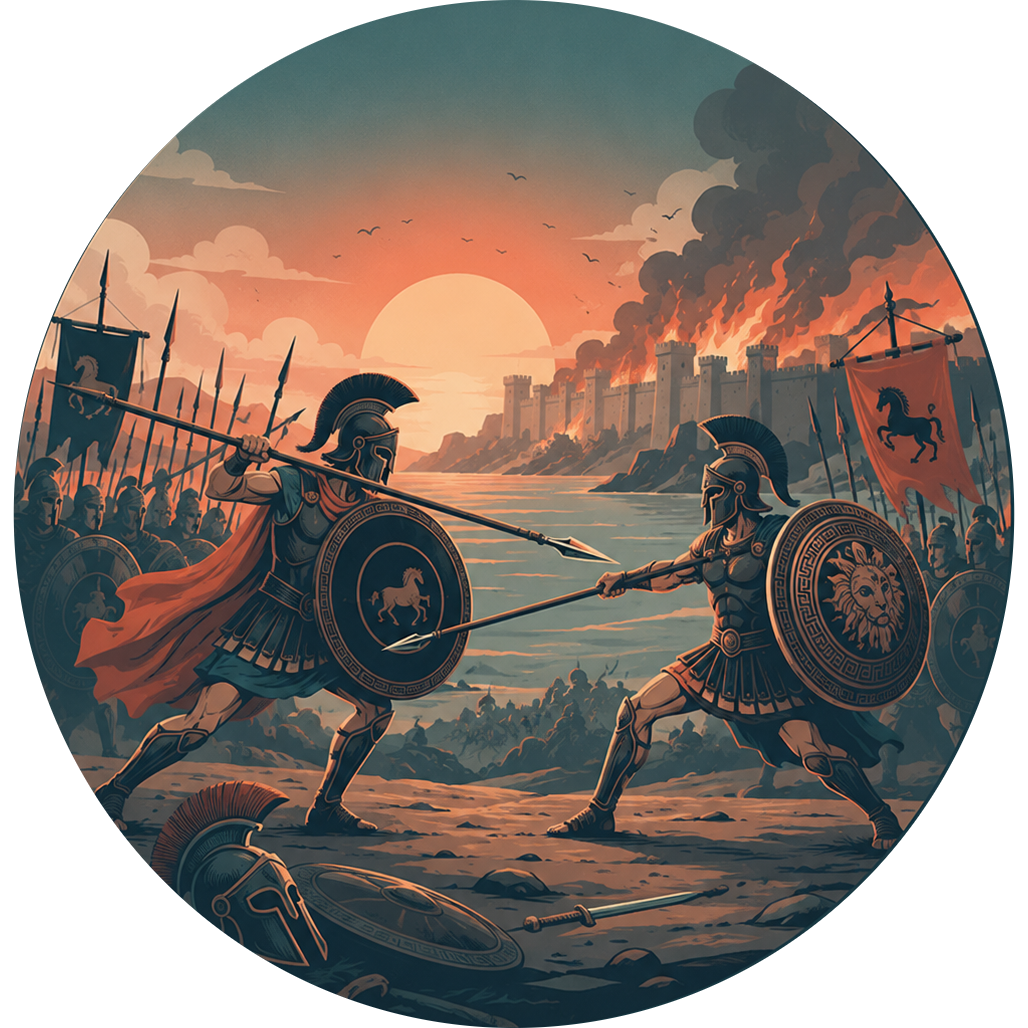
Illustration of Achilles and Hector dueling with spears beneath the burning walls of Troy
Achilles & Hector
On screen

Wolfgang Petersen's Troy (2004), with Brad Pitt as Achilles, draws its story from the poem — and with Christopher Nolan's Odyssey now reaching theaters, Homer is everywhere again. The epic beneath both is where it all begins.

Start with Fagles →
New to the poem?
01

Our recommendation

Our pick for most readers

Robert Fagles

1990 · Verse · free verse, ~6-beat line · 683 pp · Penguin Classics
“Rage — Goddess, sing the rage of Peleus' son Achilles, murderous, doomed, that cost the Achaeans countless losses…”

For most readers, this is where to begin. Fagles writes the Iliad the way it was meant to be heard — loud, headlong, and alive with the grief and fury under the fighting. His free verse carries the drama of the battlefield without ever slowing to a scholar's crawl, and it has been the version handed to students and first-time readers for more than thirty years.

It comes with Bernard Knox's long introduction, one of the finest short guides to the poem ever written. If you want a single Iliad that reads like the greatest war story ever told, this is the one.

02

Or find yours in ten seconds

Six honest questions. Answer the one that sounds like you, and take the door it opens.

03

The translations that matter

Nine translations worth knowing. Four you buy, five you can have for nothing, and the difference in price says little about the difference in pleasure.

In copyright · the modern translations

Robert Fagles

1990 · verse
★ Top pick
Free verse · ~$18 · Bernard Knox intro
“Rage — Goddess, sing the rage of Peleus' son Achilles…”

Dramatic, headlong, built to be read aloud. The classroom standard for a generation and the most natural first Iliad for almost anyone.

Best for: first-timers, drama, reading aloud, studentsOn Amazon →

Richmond Lattimore

1951 · verse
In copyright
Long line · ~$17 · the scholar's standard
“Sing, goddess, the anger of Peleus' son Achilleus…”

The closest mirror of the Greek in English, line for line, with the epithets kept where Homer set them. Demanding, but unmatched for study.

Best for: students, close readers, anyone with the Greek nearbyOn Amazon →

Robert Fitzgerald

1974 · verse
In copyright
Blank verse · ~$18 · the lyrical choice
“Anger be now your song, immortal one, Akhilleus' anger…”

The most overtly poetic of the modern versions — elevated, exact, and musical. Read it for the line itself; it asks a little more and gives it back.

Best for: readers who prize beauty of language over speedOn Amazon →

Emily Wilson

2023 · verse
In copyright
Iambic pentameter · ~$20 · line-for-line
“Goddess, sing of the cataclysmic wrath of great Achilles…”

The newest major Iliad: modern, swift, and disciplined, in regular pentameter at the Greek's own line count. A superb, readable alternative to Fagles for a first read.

Best for: readers who want a modern, fast, clear verse IliadOn Amazon →
04

Side-by-side at a glance

The same poem, nine ways. What changes is the temperament, and that is the part no table can quite capture.

TranslationYearStyleReads likeCost
Robert Fagles1990VerseDramatic, cinematicBuy
Richmond Lattimore1951VersePrecise, scholarlyBuy
Robert Fitzgerald1974VerseLyrical, elevatedBuy
Emily Wilson2023VerseFast, modern, clearBuy
Lang, Leaf & Myers1883ProseStately, biblicalFree
Alexander Pope1715–20Rhymed verseGrand, archaicFree
Samuel Butler1898ProsePlain, easyFree
William Cowper1791Blank verseDignifiedFree
George Chapman1611VerseElizabethan, denseFree

Which one is right for you? Compare every translation by reader type →

05

Common questions

Which Iliad translation should I read first?

For most first-time readers, Robert Fagles (1990) — dramatic, vivid, and built to be read aloud, with a landmark introduction by Bernard Knox. If you want the most modern voice, Emily Wilson (2023) is swift and clear; if you want to stand as close to the Greek as English allows, Richmond Lattimore (1951). And if you want it free, the Lang, Leaf & Myers prose and Samuel Butler's prose are both public domain and hosted here.

Is the Trojan Horse in the Iliad?

No — a surprise to many. The Iliad covers about fifty days in the war's tenth year and ends before Troy falls. There is no wooden horse in it. The horse and the sack of the city come from later tellings — a brief mention in the Odyssey and, most fully, Virgil's Aeneid. Here's the whole story of why →

Is the Iliad free to read?

Yes. Any translation published before about 1930 is public domain in the US, including the Lang, Leaf & Myers prose, Pope, Cowper, Butler, and Chapman. The modern translations (Fagles, Lattimore, Fitzgerald, Wilson) remain in copyright and must be bought.

Do I need to read the Iliad before the Odyssey?

No. Each epic stands completely on its own, and you can begin with either. The Iliad tells of a few weeks in the Trojan War; the Odyssey follows one soldier's ten-year journey home afterward. Neither assumes you've read the other.

Prose or verse?

Verse if you want the experience Homer intended; try Fagles or Wilson. Prose if you want the story as smoothly as possible; try Butler or the Lang, Leaf & Myers version, both free. There is no wrong answer. The best translation is the one you actually finish.

06

Going deeper

Free companions to the poem — plus an honest guide to choosing the translation that fits you.