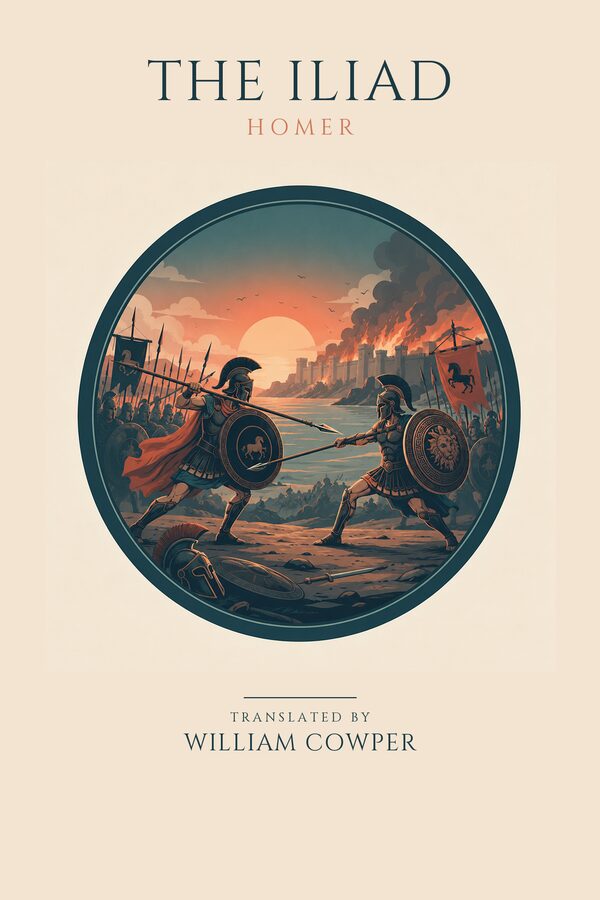
William Cowper's Iliad
“Achilles sing, O Goddess! Peleus' son; his wrath pernicious, who ten thousand woes caused to Achaia's host.”
About this edition
About This Translation
William Cowper (1731–1800) was one of the most admired English poets of his generation — the author of "The Task" and of hymns still sung today — and among the pioneers of the plainer, feeling-centered verse that would become Romanticism. In 1791 he published his complete Iliad and Odyssey in blank verse: unrhymed iambic pentameter, the measure of Milton's Paradise Lost. It was the great labor of his later years.
The Age That Made It
Cowper's Homer is, above all, a reply to Pope. He thought Pope's glittering couplets had made Homer too smooth, too ornamental, too much a poem of the drawing room — and he set out to give English a graver, more faithful Iliad by abandoning rhyme altogether for Milton's stately blank verse. Where Pope dazzles, Cowper aims to be true, sober, and dignified, letting the weight of the story rather than the wit of the couplet carry the reader.
What's Distinctive, and What's Contested
Its virtue is exactly that seriousness: closer to the Greek's plainness than Pope, unrhymed, and grave in the Miltonic manner. The recurring criticism is the other face of the same quality — that Cowper's fidelity can tip into stiffness, and his blank verse, missing both Pope's music and Homer's speed, sometimes reads as measured to the point of slowness. Admirers prize its dignity; doubters find it heavy. It is a translation more respected than loved.
How This Version Reads
Expect grave, faithful, unrhymed verse with a Miltonic solemnity — dignified and unhurried. It suits readers who want the seriousness of Homer without the artifice of rhyme, and who don't mind a stately pace. For a lighter or quicker first read, a modern verse translation or a free prose edition will carry you further, faster.
Download this translation — free
Public domain · EPUB works on Kindle, Apple Books & Kobo. No registration.
EPUB opens in Apple Books, Kobo & most readers. For Kindle, use Amazon's free Send to Kindle — it accepts EPUB too.
At a glance
- Translator
- William Cowper (1731–1800)
- Published
- 1791
- Form
- Blank verse (unrhymed iambic pentameter)
- Reads like
- Grave, faithful, Miltonic — dignified and unhurried
- Rights
- Public domain — free to download and keep
Compare other translations
Ready to read William Cowper?
Free public-domain download — EPUB works on Kindle, Apple Books & Kobo.