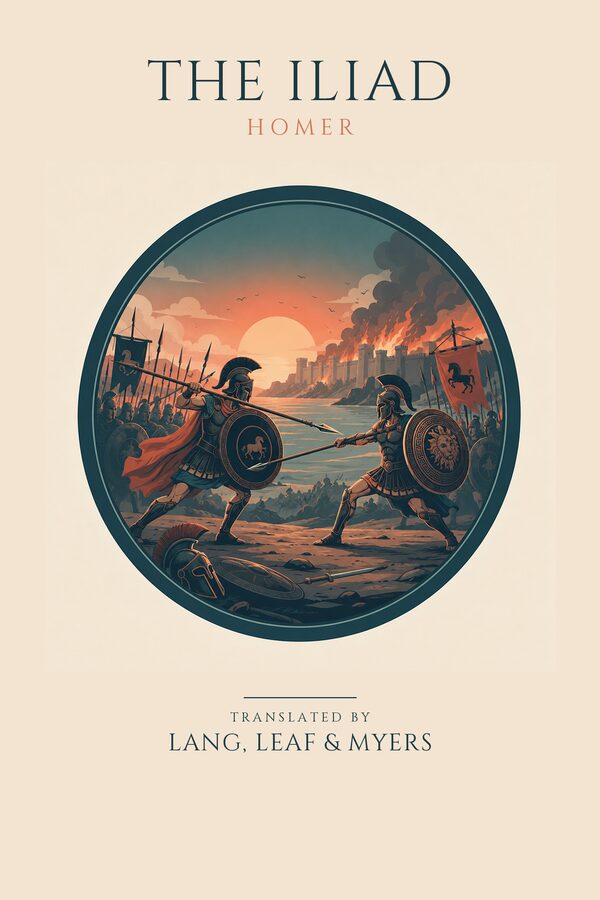
Lang, Leaf & Myers' Iliad
“Sing, goddess, the wrath of Achilles Peleus' son, the ruinous wrath that brought on the Achaians woes innumerable.”
About this edition
About This Translation
The 1883 prose Iliad of Andrew Lang, Walter Leaf, and Ernest Myers is the Victorian era's definitive prose rendering of the poem — the Iliad's counterpart to the Butcher & Lang Odyssey that appeared a few years before it. Its three translators were formidable men of letters: Lang a folklorist, poet, and tireless popularizer of the classics; Leaf one of the great Homeric scholars of his age, whose edition of the Greek text is still consulted; Myers a poet and essayist. Between them they set out to carry the whole poem into English prose without losing its weight.
The Age That Made It
The translation is written in a deliberately antique, "biblical" English — the cadence of the King James Bible, with its thee and thou and its rolling, subordinate clauses. This was a conscious choice, not an accident of the calendar. To late-Victorian ears, that register was the natural sound of the sacred and the ancient, and the translators reached for it to make Homer feel as old and grave in English as he felt in Greek. The result reads less like a novel than like scripture.
What's Distinctive, and What's Contested
Its great virtue is fidelity. Freed from the demands of meter and rhyme, the translators could follow the Greek closely, and Leaf's scholarship keeps the sense exact; for more than a century it was the prose Iliad students were pointed to when they wanted to know what Homer actually says. The trade-off is the archaism itself: what struck 1883 as grave and beautiful can strike a modern reader as remote, and the very solemnity that gives the prose its dignity can slow a first encounter. Whether that exchange suits you is largely a matter of ear.
How This Version Reads
Expect stately, measured prose with a scriptural gravity — faithful, dignified, and unhurried. It is the free edition to reach for when you want closeness to the Greek and the feeling of antiquity, and are willing to meet an older English halfway. Readers who prefer something plainer and quicker will find Samuel Butler's prose the easier door.
Download this translation — free
Public domain · EPUB works on Kindle, Apple Books & Kobo. No registration.
EPUB opens in Apple Books, Kobo & most readers. For Kindle, use Amazon's free Send to Kindle — it accepts EPUB too.
At a glance
- Translators
- Andrew Lang, Walter Leaf & Ernest Myers
- Published
- 1883
- Form
- Prose
- Reads like
- Stately, "biblical" Victorian prose — faithful and grave
- Rights
- Public domain — free to download and keep
Compare other translations
Ready to read Lang, Leaf & Myers?
Free public-domain download — EPUB works on Kindle, Apple Books & Kobo.