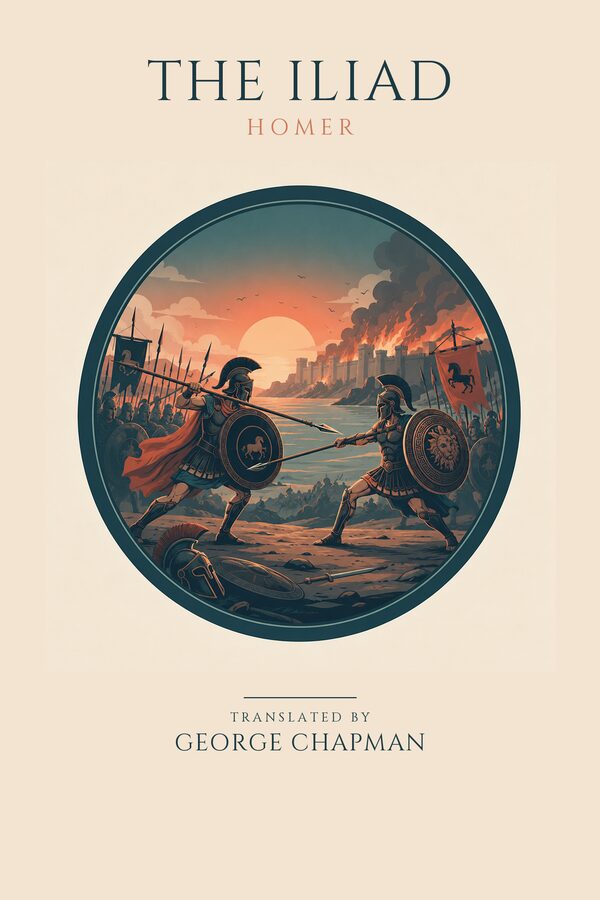
George Chapman's Iliad
“Achilles' baneful wrath resound, O Goddess, that impos'd / Infinite sorrows on the Greeks…”
About this edition
About This Translation
George Chapman (c. 1559–1634) was an Elizabethan poet and dramatist, a contemporary of Shakespeare, and the man who gave English its first complete Homer. He published the Iliad in installments and then whole in 1611, following it with the Odyssey — a labor he regarded as the great work of his life. His Iliad is written in "fourteeners": long, rhymed lines of fourteen syllables that roll and gallop across the page.
The Age That Made It
This is Homer in the full voice of the English Renaissance — copious, energetic, and unafraid. Chapman writes with the exuberance of his age, expanding where he feels the sense demands it, pressing his own moral and philosophical convictions into the margins of the story. The result is less a transparent translation than a Renaissance poet's impassioned recreation, closer in spirit to Marlowe and the Elizabethan stage than to a modern crib.
What's Distinctive, and What's Contested
Its fame rests partly on its own power and partly on a sonnet: in 1816 John Keats stayed up all night reading it and wrote "On First Looking into Chapman's Homer," describing the shock of discovery as a watcher of the skies when a new planet swims into his ken. That is the promise and the warning of Chapman together. It is thrilling, muscular, and unlike anything since — and also archaic, free with the Greek, and, in its rolling fourteeners, genuinely demanding for a modern reader. You read Chapman for the electricity, not for the ease.
How This Version Reads
Expect dense, rhymed, Elizabethan verse of tremendous drive — exhilarating for lovers of old English poetry, and a real climb for anyone meeting the story for the first time. It is best approached as a great poem in its own right, ideally once you already know the shape of the Iliad. For a first read, start with a modern version or a free prose edition, then come to Chapman for the fireworks.
Download this translation — free
Public domain · EPUB works on Kindle, Apple Books & Kobo. No registration.
EPUB opens in Apple Books, Kobo & most readers. For Kindle, use Amazon's free Send to Kindle — it accepts EPUB too.
At a glance
- Translator
- George Chapman (c. 1559–1634)
- Published
- 1598–1611 (complete Iliad 1611)
- Form
- Rhymed verse ("fourteeners")
- Reads like
- Dense, energetic, Elizabethan — thrilling and demanding
- Rights
- Public domain — free to download and keep
Compare other translations
Ready to read George Chapman?
Free public-domain download — EPUB works on Kindle, Apple Books & Kobo.